Eliminata per emigrazioneStruck off for emigration
Anagrafe del Comune di Maida · 10 maggio 1986
Civil registry of the Comune of Maida · 10 May 1986
Non è una metafora e non è un modo di dire. È scritto davvero, con la penna di un impiegato, su una scheda vera, di una donna vera. Rosa Cervadoro, nata a Maida il 15 giugno 1893. Vedova di guerra. Cancellata a quasi novantatré anni.
This is not a metaphor and not a figure of speech. It is really written, in a clerk’s hand, on a real card, about a real woman. Rosa Cervadoro, born in Maida on 15 June 1893. A war widow. Struck off at almost ninety three.
Era la sorella di mio nonno
She was my grandfather’s sister
Maida, 1899
Maida, 1899
Il paese che lo Stato vedeva
The town the State could see
Nel 1899 una guida stampata a Roma descrive Maida con la precisione di un inventario. Il paese c’è tutto: le autorità, le professioni, il commercio, perfino gli orari delle corse postali. È un documento ordinato, completo, credibile.
In 1899 a directory printed in Rome describes Maida with the precision of an inventory. The whole town is there: the authorities, the professions, the trade, even the times of the mail coaches. It is an orderly document, complete, credible.
Cervadoro Aristodemo · Ciriaco Michele · Cinque Vincenzo
Notai
Palermo Domenico · Palermo Pietro · Pileggi Pasquale
Librai
Riccio F.
Legatori di libri
Martucci Giovanni
Alberghi
Dei Fiori · La Rosa · Umberto I
Uffici
Ufficio postale, ufficio telegrafico, stazione ferroviaria sulla linea Eboli-Reggio, servizio omnibus. Tre corse postali al giorno
Del castello
«attualmente ridotto a carcere»
Ci sono tre farmacisti e tre medici. Ci sono i notai, i venti produttori d’olio, i dieci panettieri, le sei donne che hanno un esercizio a proprio nome. C’è un libraio e c’è chi rilega i libri. C’è il telegrafo, c’è la stazione, ci sono tre alberghi. Maida nel 1899 non era un paese isolato dal mondo: era un paese collegato al mondo.
There are three pharmacists and three doctors. There are the notaries, the twenty olive oil producers, the ten bakers, the six women trading under their own name. There is a bookseller and a man who binds books. There is the telegraph, the railway station, three hotels. Maida in 1899 was not a town cut off from the world: it was a town connected to the world.
E in quel paese, in quell’anno, in via Garibaldi, c’era un sarto che si chiamava Francesco Cervadoro. Era mio bisnonno. In quelle pagine non c’è.
And in that town, in that year, in via Garibaldi, there was a tailor named Francesco Cervadoro. He was my great grandfather. He is not on those pages.
Non c’è lui e non c’è nessun sarto. Non c’è nessun calzolaio, non c’è nessuna tessitrice, e ce n’erano decine. L’annuario registrava chi aveva ditta e licenza: chi lavorava in casa, per il paese, non entrava nel Regno d’Italia. Non per cattiveria. Per modulistica.
He is not there, and no tailor is. No shoemaker, no weaver, and there were dozens of them. The directory recorded those with a registered business and a licence: whoever worked at home, for the town, did not enter the Kingdom of Italy. Not out of malice. Out of paperwork.
Il meccanismo
The mechanism
Chi scrive i nomi, e chi non li scrive
Who writes the names down, and who does not
La stessa mano che nel 1899 lascia fuori l’artigiano, novant’anni dopo scrive «eliminato» accanto a chi parte. E in mezzo, una volta sola, qualcuno fa il contrario.
The same hand that in 1899 leaves the artisan out, ninety years later writes «struck off» beside those who leave. And in between, just once, somebody does the opposite.
1899
L’annuario del Regno registra il commercio e dimentica l’artigianato. Nove sarti, venti calzolai, sette tessitrici: nessuno di loro esiste sulla carta.
The Kingdom’s directory records trade and forgets craft. Nine tailors, twenty shoemakers, seven weavers: none of them exists on paper.
1986 · 1992
L’anagrafe registra chi resta e cancella chi parte. La parola stampata nei moduli è eliminato, e vale per una prozia di novantatré anni come per un padre di quarantanove.
The civil registry records those who stay and deletes those who leave. The word printed on the forms is struck off, and it applies to a great aunt of ninety three as to a father of forty nine.
1990
Un sacerdote di Maida, don Giancarlo Leone, gira il paese e scrive a memoria i nomi degli artigiani prima che si perdano. È l’unico censimento esistente di quella Maida.
A priest of Maida, don Giancarlo Leone, walks the town and writes down the artisans’ names from memory before they are lost. It is the only existing census of that Maida.
Il Registro dei Dimoranti fa, per chi è partito, quello che don Leone fece per chi era rimasto.
The Register of Dimoranti does, for those who left, what don Leone did for those who stayed.
Sei generazioni
Six generations
L’Albero del Filo
The Tree of the Thread
Il filo che i sarti tagliavano e le tessitrici tessevano è lo stesso che tiene insieme queste sei generazioni. Nessun nome è a memoria. Ogni riga che segue sta su un atto dello stato civile del Comune di Maida, dal registro borbonico del 1832 al 1969. Sotto ogni nome, il mestiere. A fianco, in piccolo, quello che le carte dicono senza volerlo.
The thread the tailors cut and the weavers wove is the same thread that holds these six generations together. No name here comes from memory. Every line below rests on a civil status record of the Comune of Maida, from the Bourbon register of 1832 to 1969. Under each name, the trade. Alongside, in small type, what the papers say without meaning to.
I
Francesco Cervadoro
nato intorno al 1800
born around 1800
con Maria Ciliberto
with Maria Ciliberto
È il punto più antico che i documenti raggiungono. Nel marzo del 1832 ha trentadue anni e abita in una strada che l’atto chiama Sant’Angelo. Il mestiere, sulla carta, non è ancora leggibile con certezza.
This is the oldest point the documents reach. In March 1832 he is thirty two and lives on a street the record calls Sant’Angelo. His trade, on paper, cannot yet be read with certainty.
II
Nicola Cervadoro
Maida, 9 marzo 1832, ore nove
Maida, 9 March 1832, nine o’clock
SartoTailor
con Elisabetta Gatto
with Elisabetta Gatto
L’atto è ancora quello del Regno delle Due Sicilie: comune di Maida, distretto di Nicastro, provincia di Calabria Ultra Seconda. Il bambino viene «presentato» e «ocularmente riconosciuto», e a margine il parroco restituisce il foglio certificando il battesimo. Sulla stessa pagina firmano lo Stato e la Chiesa.
The record is still that of the Kingdom of the Two Sicilies: comune of Maida, district of Nicastro, province of Calabria Ultra Seconda. The child is «presented» and «recognised by sight», and in the margin the parish priest returns the sheet certifying the baptism. On the same page the State and the Church both sign.
Nel 1856, davanti all’ufficiale, risulta non saper scrivere.
In 1856, before the registrar, he is recorded as unable to write.
III
Francesco Cervadoro
Maida, 31 dicembre 1856 – Maida, 28 aprile 1947
Maida, 31 December 1856 – Maida, 28 April 1947
SartoTailorVia Garibaldi 97Via Garibaldi 97
prime nozze con Maria Mancuso, da cui Pietro nel 1884 · poi con Nicolina Doria, tessitrice, da cui Rosa nel 1893 e Costantino nel 1909
first married Maria Mancuso, father of Pietro in 1884 · then Nicolina Doria, a weaver, father of Rosa in 1893 and Costantino in 1909
Visse novant’anni e attraversò per intero la grande emigrazione: ne aveva ventiquattro nel 1880 e sessantaquattro alla fine del 1920. Alla sua nascita i testimoni sono due «proprietari regnicoli», cioè i clienti del sarto. Alla sua morte, i dichiaranti sono due calzolai.
He lived ninety years and crossed the whole of the great emigration: he was twenty four in 1880 and sixty four at the end of 1920. At his birth the witnesses are two landowners, that is, the tailor’s customers. At his death, the two men who declare it are shoemakers.
È l’uomo del 1899 che la guida del Regno non registra.
He is the man of 1899 whom the Kingdom’s directory does not record.
IV
Costantino Cervadoro, detto Dino
Costantino Cervadoro, known as Dino
Maida, 12 marzo 1909 – Maida, 8 febbraio 1975
Maida, 12 March 1909 – Maida, 8 February 1975
SartoTailor
con Giovanna Isabella, dal 21 ottobre 1939
with Giovanna Isabella, from 21 October 1939
Nato alle tre e mezza del mattino in via Garibaldi 89, dichiarato tre giorni dopo dal padre, che di anni ne aveva cinquantatré. Nell’atto si legge che il bambino non fu portato in Municipio «a causa del tempo inclemente ed umido».
Born at half past three in the morning at via Garibaldi 89, declared three days later by his father, then fifty three. The record says the child was not brought to the town hall «on account of the inclement and damp weather».
Nel 1990, nella ricerca di don Leone, è uno dei nove sarti di Maida, e compare col nome che gli dava il paese: Dino.
In 1990, in don Leone’s research, he is one of Maida’s nine tailors, listed under the name the town gave him: Dino.
V
Francesco Rocco Cosimo Antonio Cervadoro
Maida, 9 aprile 1943 – 16 gennaio 1995
Maida, 9 April 1943 – 16 January 1995
MeccanicoMechanic
con Ida Ciliberto, dal 19 ottobre 1968
with Ida Ciliberto, from 19 October 1968
Nacque alle dieci di sera nella stessa casa in cui quattro anni dopo morì il bisnonno: si sono conosciuti. Con lui la linea dei sarti si interrompe. È il primo che tocca il metallo invece della stoffa, e il primo che parte: Svizzera, poi Stati Uniti, undici anni.
He was born at ten at night in the same house where four years later his great grandfather died: they knew each other. With him the line of tailors stops. He is the first to work metal instead of cloth, and the first to leave: Switzerland, then the United States, eleven years.
Eliminato per emigrazione · 26 maggio 1992Struck off for emigration · 26 May 1992Reiscritto · 9 settembre 1993Re-entered · 9 September 1993Eliminato di nuovo · 13 settembre 1994Struck off again · 13 September 1994
Tre volte in due anni. E la cosa che pesa più di tutte: per l’anagrafe di Maida, prima del 1992, quest’uomo non era mai partito. Né per la Svizzera, né per l’America. Undici anni all’estero e la casella resta vuota.
Three times in two years. And the heaviest fact of all: for the registry of Maida, before 1992, this man had never left. Not for Switzerland, not for America. Eleven years abroad and the box stays empty.
VI
Costantino Gianluca Cervadoro
Olten, Svizzera, 11 agosto 1969
Olten, Switzerland, 11 August 1969
Il mio atto di nascita non è nato a Maida: è arrivato a Maida. Lo trascrisse il 25 agosto 1969, dalla copia inviata dal Consolato Generale d’Italia in Basilea, Antonio Cervadoro, assessore delegato.
My birth record was not born in Maida: it arrived in Maida. It was transcribed on 25 August 1969, from the copy sent by the Italian Consulate General in Basel, by Antonio Cervadoro, delegated councillor.
Mia sorella e mio fratello nacquero a Filadelfia. Tutti e tre entrammo a Maida il 7 marzo 1980, e sulle nostre schede c’è scritto: «prima iscrizione per provenienza dagli U.S.A.». Figli immigrati di un padre che, per lo Stato, non era mai emigrato.
My sister and my brother were born in Philadelphia. All three of us entered Maida on 7 March 1980, and our cards read: «first entry, arriving from the U.S.A.». Immigrant children of a father who, for the State, had never emigrated.
Nel 1992 la famiglia si disperde di nuovo: mio padre altrove, mia sorella e mio fratello ad Asti con la stessa pratica. Io sono l’unico che è rimasto a Maida.
In 1992 the family scatters again: my father elsewhere, my sister and my brother to Asti on the same paperwork. I am the only one who stayed in Maida.
prime nozze, senza figli · poi padre di
first marriage, no children · then father of
AlessandraFederica
Gli atti di una sola famiglia di sarti contengono le firme di chi governava Maida dal 1832 al 1969: sindaci, assessori, segretari, un podestà, due parroci. Un archivio di famiglia è un archivio civico che nessuno ha ordinato.
The records of a single family of tailors carry the signatures of those who governed Maida from 1832 to 1969: mayors, councillors, secretaries, a podestà, two parish priests. A family archive is a civic archive that nobody ordered.
Nella famiglia, accanto a questa linea, corre un ramo di calzolai, e da quel ramo è venuto Francesco Nicola Cervadoro, artigiano, combattente del 1918, Sindaco di Maida dal 1960 al 1965. Nel 1735 un altro Cervadoro, «maestro Francesco», ricevette a Maida il re Carlo III. Due artigiani con lo stesso cognome hanno rappresentato il popolo di Maida a duecentoventicinque anni di distanza.
Beside this line, within the family, runs a branch of shoemakers, and from that branch came Francesco Nicola Cervadoro, an artisan, a soldier of 1918, Mayor of Maida from 1960 to 1965. In 1735 another Cervadoro, «master Francesco», received King Charles III in Maida. Two artisans with the same surname represented the people of Maida two hundred and twenty five years apart.
L’altra metà dell’arte
The other half of the craft
Le donne del telaio
The women at the loom
Gli uomini tagliavano la stoffa e il cuoio. Le donne la tessevano, generazione dopo generazione, e nei documenti di famiglia il loro mestiere compare sempre, scritto accanto al nome del marito.
The men cut the cloth and the leather. The women wove it, generation after generation, and in the family records their trade always appears, written beside their husband’s name.
Nicolina DoriaTessitrice · atto del 1909Weaver · 1909 record
Maria CervadoroTessitrice · nata nel 1869Weaver · born 1869
Giuseppina LopreteTessitrice · atto del 1925Weaver · 1925 record
Nicolina CervadoroRicamatrice · nata nel 1906Embroiderer · born 1906
Caterina ScalfaroTessitrice · atto del 1932Weaver · 1932 record
«A Zurzija»Tessitrice · senza nome e senza cognomeWeaver · no first name, no surname
L’ultima riga non è un errore. Nell’elenco delle tessitrici raccolto da don Leone, una donna compare soltanto con il soprannome che le dava il paese, fra virgolette. I nove sarti uomini hanno tutti nome e cognome. L’asimmetria è essa stessa un documento.
The last line is not a mistake. In the list of weavers gathered by don Leone, one woman appears only under the nickname the town gave her, in quotation marks. The nine male tailors all have a first name and a surname. The asymmetry is itself a document.
Agli emigrati lo Stato scriveva «eliminato». A lei il paese non ha scritto nemmeno il nome.
To those who emigrated the State wrote «struck off». To her, the town did not even write a name.
1918
1918
La prima iscrizione, novant’anni prima del Registro
The first entry, ninety years before the Register
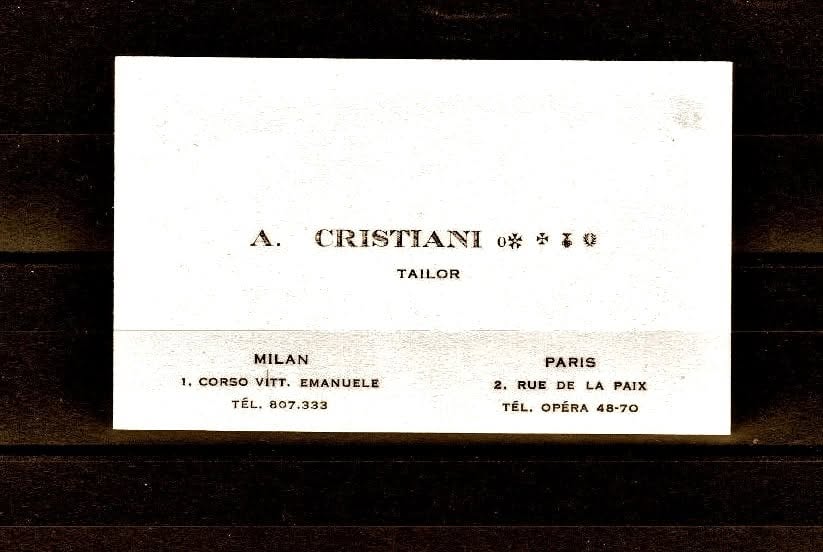
Il biglietto di Antonio Cristiani, sarto di Maida: due indirizzi, Milano, corso Vittorio Emanuele, e Parigi, rue de la Paix. Documento trasmesso da Gregorio Colistra.
The card of Antonio Cristiani, tailor of Maida: two addresses, Milan, corso Vittorio Emanuele, and Paris, rue de la Paix. Document passed on by Gregorio Colistra.
Antonio Cristiani era un sarto di Maida emigrato a Parigi. Nel giugno del 1918 combatté a Bligny con i francesi, e fece pubblicare la propria fotografia su «La Charte», il giornale degli emigrati italiani in Francia. Sul retro scrisse una nota a mano e la indirizzò a un Cervadoro di Maida, con la richiesta di consegnarla allo storico del paese.
Antonio Cristiani was a tailor from Maida who had emigrated to Paris. In June 1918 he fought at Bligny with the French, and had his photograph published in «La Charte», the newspaper of Italian emigrants in France. On the back he wrote a note by hand and addressed it to a Cervadoro of Maida, asking that it be handed to the town’s historian.
Non chiese diritti. Non chiese la cittadinanza, che aveva. Non chiese soldi. Chiese una cosa sola: che a Maida qualcuno sapesse chi era.
He asked for no rights. He did not ask for citizenship, which he had. He asked for no money. He asked for one thing only: that in Maida someone should know who he was.
La catena si è chiusa in quasi cent’anni: Cristiani decise, un Cervadoro custodì, lo storico Gregorio Colistra archiviò e studiò, e poi consegnò quella carta a me. È di fatto la prima iscrizione al Registro dei Dimoranti, novant’anni prima che il Registro esistesse.
The chain closed over almost a century: Cristiani decided, a Cervadoro kept, the historian Gregorio Colistra filed and studied, and then handed that paper to me. It is in fact the first entry in the Register of Dimoranti, ninety years before the Register existed.
Dimmi da dove vengo e ti dico dove vado.
Tell me where I come from and I will tell you where I am going.
Luca Cervadoro
Luca Cervadoro
Quello che chiedono da lontano
What they ask from far away
Non chiedono documenti. Chiedono di sapere chi sono.
They are not asking for documents. They are asking to know who they are.
In quindici anni mi hanno scritto da Youngstown, da Resistencia, da Madison, da Filadelfia, dalla Svizzera, dall’Australia. Hanno sempre chiesto la stessa cosa, con parole diverse. Non il passaporto. Non l’eredità. Appartenenza.
In fifteen years they have written to me from Youngstown, Resistencia, Madison, Philadelphia, Switzerland, Australia. They have always asked the same thing, in different words. Not a passport. Not an inheritance. Belonging.
E si sa chi si è in un modo solo: sapendo da chi si viene e che cosa quella gente faceva con le mani. Un sarto, un calzolaio, una tessitrice, un meccanico, uno scrivano. Il mestiere è la prima lingua di una famiglia, e a emigrare non è solo la persona: a emigrare è il mestiere. Il banchetto del calzolaio di Maida diventa una fabbrica di scarpe a Filadelfia; il sarto di via Garibaldi diventa il sarto di Parigi e il sarto di Ocean City.
And there is only one way to know who you are: knowing who you come from and what those people did with their hands. A tailor, a shoemaker, a weaver, a mechanic, a scribe. A trade is a family’s first language, and it is not only the person who emigrates: the trade emigrates too. The shoemaker’s bench in Maida becomes a shoe factory in Philadelphia; the tailor of via Garibaldi becomes the tailor of Paris and the tailor of Ocean City.
Per questo esiste il Registro dei Dimoranti. Non restituisce diritti: restituisce il nome. È l’atto con cui un Comune scrive, accanto a chi è partito, qualcosa che non sia «eliminato».
This is why the Register of Dimoranti exists. It restores no rights: it restores the name. It is the act by which a town writes, beside those who left, something other than «struck off».
Atti dello stato civile del Comune di Maida, dal registro borbonico del 1832 agli atti del 1969: nascite, matrimoni, morti, schede individuali e fogli di famiglia.
Civil status records of the Comune of Maida, from the Bourbon register of 1832 to the records of 1969: births, marriages, deaths, individual cards and family sheets.
Annuario d’Italia, guida generale del Regno, Bontempelli, Roma, 1899, voce Maida.
Annuario d’Italia, guida generale del Regno, Bontempelli, Rome, 1899, entry for Maida.
Ricerca di don Giancarlo Leone sui mestieri di Maida, 1990: gli elenchi dei sarti, dei calzolai e delle tessitrici, raccolti dalla voce della gente.
Don Giancarlo Leone’s research on the trades of Maida, 1990: the lists of tailors, shoemakers and weavers, gathered from people’s own voices.
Documenti trasmessi da Gregorio Colistra, storico di Maida, fra cui la nota di Antonio Cristiani.
Documents passed on by Gregorio Colistra, historian of Maida, including Antonio Cristiani’s note.
Della voce del 1899 si citano gli elenchi e non la descrizione geografica, che ricicla una geografia anteriore al 1783. Dove un dato è ancora da verificare sull’originale, questa pagina lo dice.
From the 1899 entry only the lists are cited, not the geographical description, which recycles a geography predating 1783. Where a detail still has to be checked against the original, this page says so.
La stanza dell’albero
The room of the tree
visitatori entrati fin qui · tu sei l’ultimo della fila, per ora
visitors so far · you are the latest in the line, for now